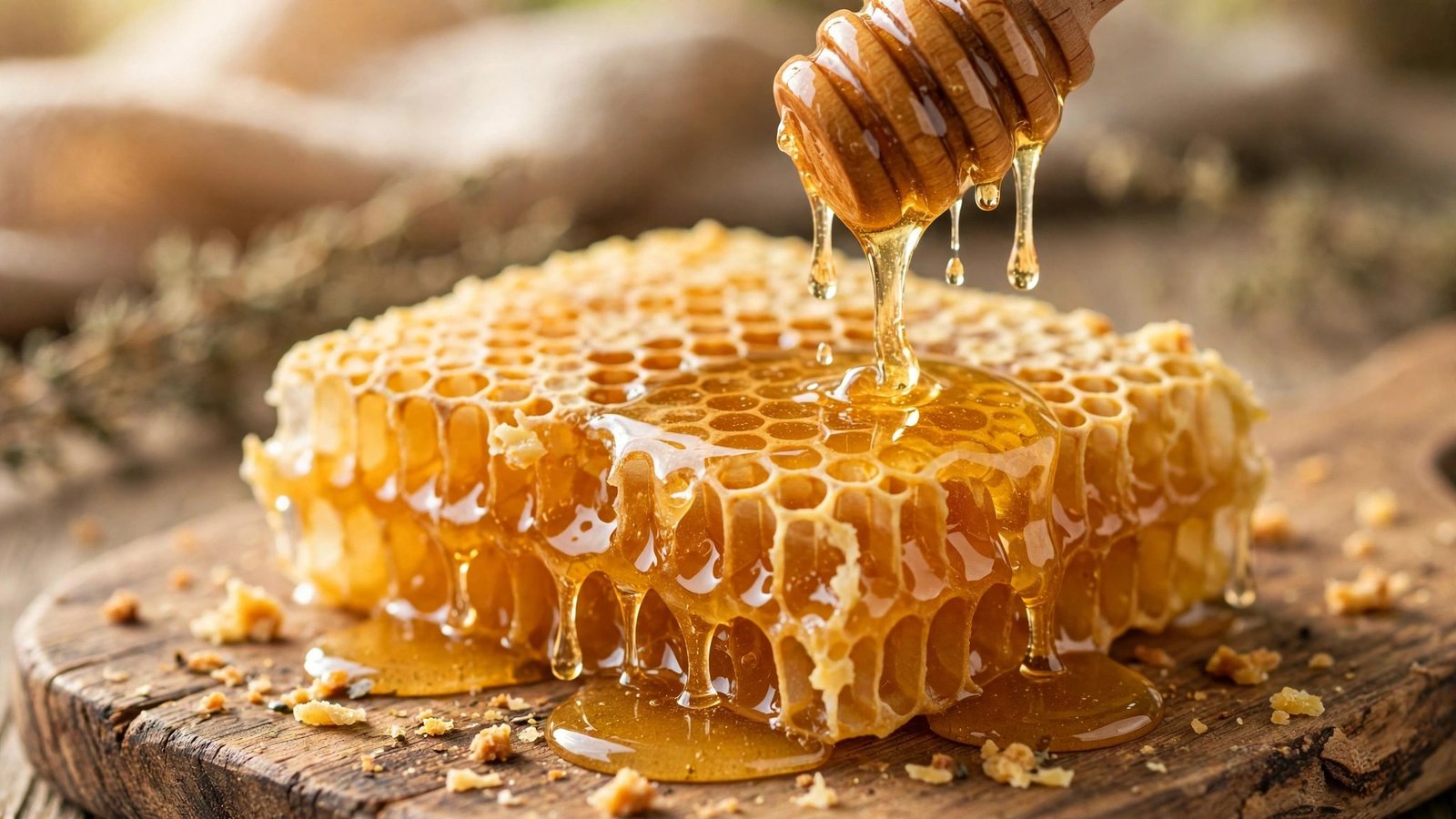
You eat the entire thing — wax and all. Honeycomb is simply raw honey still sealed in the beeswax cells the bees built, and the wax is completely edible. Cut off a chunk, pop it in your mouth, and chew: the honey floods out while the wax softens into something like a natural chewing gum. Spreading it on warm toast or crumbling it over cheese are the classic ways to serve it.
Do you eat the wax or spit it out?
Eat it. Beeswax is food-safe, non-toxic and has been eaten for millennia. Chewed wax eventually breaks down into small, soft granules you swallow without noticing — most people don’t even register it once the honey has melted away. If the waxy texture genuinely bothers you, there is no shame in discreetly discarding the chewed wax, but you will be missing nothing nutritionally either way; wax passes through undigested.
The best ways to serve honeycomb
On warm toast or crumpets
The undisputed champion. Warm bread softens the wax and lets the honey seep in. A thick slice of sourdough or a buttered crumpet with a slab of comb on top is one of breakfast’s great pleasures. Add nothing else — butter is optional and arguably gilding the lily.
With cheese
Honeycomb and cheese is a combination the Italians and Spaniards have celebrated for centuries, and it works brilliantly with British cheeses too. Try it with a salty blue like Stilton, a mature Cheddar, or a creamy goat’s cheese. The salt-sweet contrast is extraordinary on a cheeseboard.
Over yoghurt and porridge
A chunk of comb melting into hot porridge or stirred through thick Greek yoghurt with toasted nuts makes a breakfast worth getting up for. The wax softens in the heat and virtually disappears.
Straight from the comb
No preparation, no ceremony. Cut a square, chew, enjoy. This is how beekeepers eat it, and honestly it might be the best way — honeycomb at room temperature, eaten as nature intended.
Buying and storing honeycomb
Look for comb honey in farm shops, farmers’ markets, delis and the honey aisle of larger supermarkets — a 300–400g section typically costs £8–£15 in the UK. Good comb should look golden and intact, with capped cells glistening. Store it at room temperature in a sealed container; never refrigerate it, as cold accelerates crystallisation. If your comb does crystallise, our guides to keeping honey from crystallising and how to de-crystallise honey apply equally.
The British Beekeepers Association lists local beekeepers selling raw comb honey across the UK — buying direct is usually cheaper and fresher.
Cooking and baking with honeycomb
Beyond the cheeseboard, honeycomb earns its keep in the kitchen. Chop it roughly and fold it through vanilla ice cream in the last minutes of churning for a magnificent honeycomb ripple. Melt a chunk into salad dressings for a floral sweetness that jarred honey can’t quite match. It is superb drizzled — wax softened — over roasted figs, grilled peaches or a baked Camembert. And crushed comb makes a brilliant topping for flapjacks and honey cake, where the little pockets of wax add an intriguing chew. One caution: don’t use it where you need precise sweetness, as comb honey varies in intensity from cell to cell — taste as you go.
What to look for when buying honeycomb
Not all comb honey is equal. Look for sections where the cells are fully capped — the wax seals should look intact and slightly domed, which means the honey inside is ripe and won’t ferment. The comb should be golden and translucent rather than dull or cloudy. “Cut comb” (a square cut from a frame) and “section” honey (produced in a small wooden frame the bees fill directly) are the two main formats; sections tend to be neater and pricier. Check the label for the floral source — heather, orange blossom and wildflower combs each taste strikingly different. Raw, unfiltered comb from a local beekeeper is the gold standard: it hasn’t been heated, so the delicate floral aromas survive intact. Avoid anything labelled “honeycomb” that lists glucose syrup or added flavourings — that’s confectionery, not comb honey.
A note on honey and babies
Honey — including honeycomb — should never be given to children under 12 months old, as it can contain bacteria that cause infant botulism. This is NHS guidance and applies to all raw honey products.
FAQs
Is it safe to eat honeycomb wax?
Yes. Beeswax is entirely edible and non-toxic. It softens as you chew and passes through the digestive system harmlessly.
How do you cut honeycomb?
Use a warm, sharp knife and cut straight down through the comb — a cold knife drags and crushes the cells. Cut only what you’ll eat; the remaining comb keeps better intact.
Does honeycomb go off?
Practically never. Sealed honey is one of the few foods that doesn’t spoil — archaeologists have found edible honey in ancient Egyptian tombs. Keep it sealed at room temperature and it lasts indefinitely, though it may crystallise over time.
What’s the difference between honeycomb and regular honey?
Honeycomb is honey in its most natural state — still in the wax cells, completely unprocessed and unfiltered. Jarred honey has been extracted from the comb, usually filtered, and sometimes gently heated.