You’re expecting a baby, the old hatchback suddenly feels tiny, and everyone has an opinion about which SUV you “need.” Walk into the choice unprepared and you’ll drown in trim levels, NCAP stars, and salespeople steering you toward the most expensive model. Choosing a family SUV with top safety ratings as a complete beginner doesn’t require becoming a car expert — it requires knowing which five things actually matter, which ratings to trust, and how to ignore the noise. Here’s the beginner’s roadmap.
Start With Safety Ratings: The Only Numbers That Matter
Forget marketing claims about “safety” — use the independent Euro NCAP ratings at euroncap.com. Every major model is crash-tested and scored out of five stars across four categories: adult occupant, child occupant, pedestrian protection, and safety assist (the electronic systems). For a family SUV, prioritise child occupant scores and safety assist — the latter covers autonomous emergency braking, lane-keeping, and blind-spot monitoring, the systems that prevent crashes rather than just surviving them.
Two crucial nuances: ratings expire in relevance — a 5-star rating from 2019 was tested against easier standards than a 5-star from 2025 (Euro NCAP toughens tests every couple of years), so compare ratings from the same era. And stars aren’t everything — read the actual test notes, especially the child-occupant section, which details how specific child seats performed in that exact car.
The Five Things That Actually Matter (Beyond Stars)
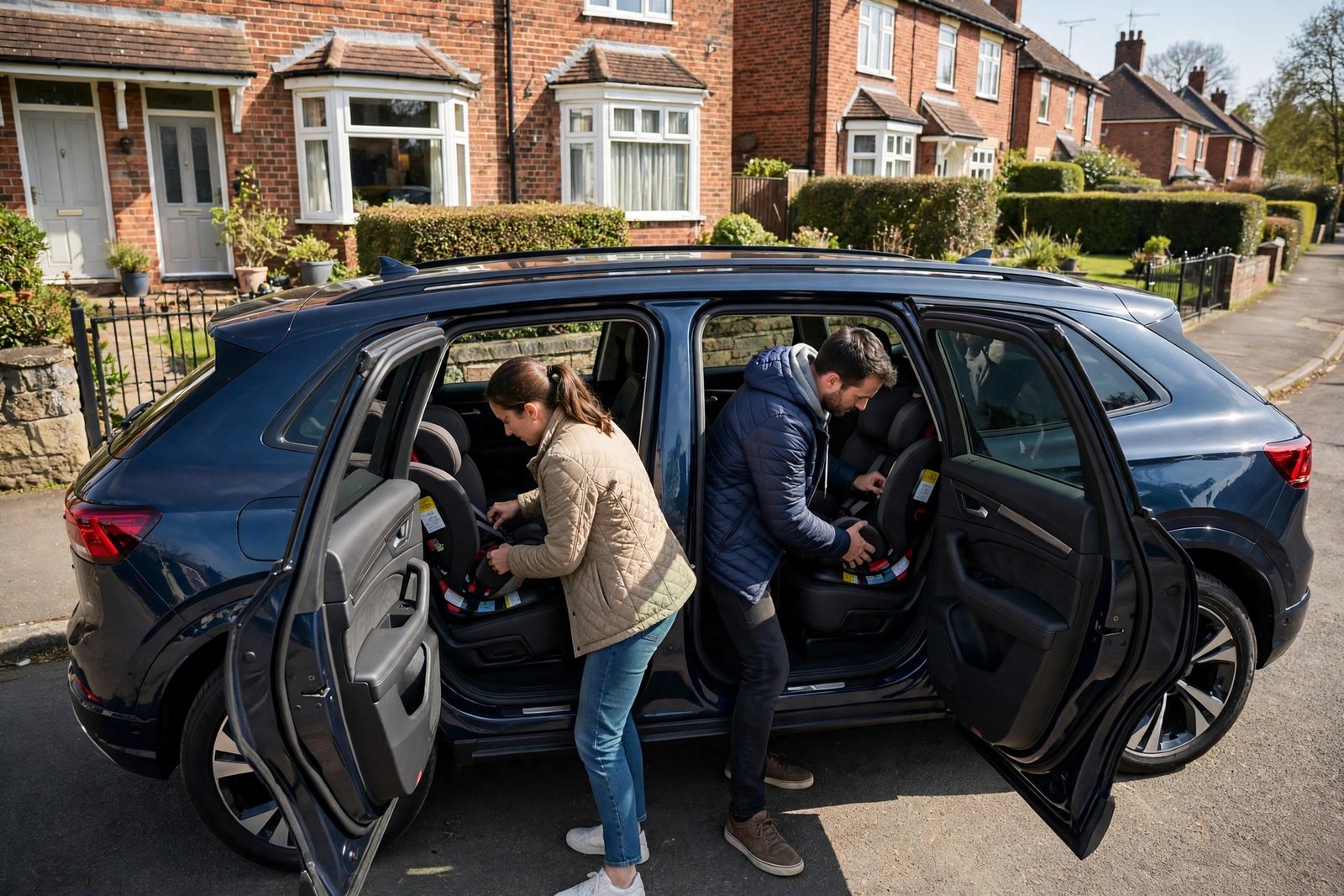
1. Real-world child seat fit. Bring your actual child seats to every test drive and install them. Check: do they fit without forcing? Can an adult still sit alongside? Do the ISOFIX points align sensibly? Can rear doors open wide enough in tight parking spaces? A 5-star car that fights your child seats daily is a bad buy.
2. Boot space with the seats up. Manufacturers quote boot volume, but the shape matters more than litres — a square, flat-loading boot swallows a pram; a sloping, shallow one doesn’t. Bring the pram (or the dog crate, or the golf clubs) to the dealership. If it doesn’t fit, nothing else matters.
3. Rear-seat space for growing kids. Toddlers fit anywhere; teenagers don’t. Check legroom with the front seats in your driving position, headroom, and whether three child seats (or two plus a teenager) genuinely fit across. Sliding rear benches — which let you trade boot space for legroom — are a brilliant family feature.
4. Running costs, honestly calculated. The purchase price is just the entry ticket. Bigger SUVs mean higher fuel/energy costs, higher insurance groups, pricier tyres, and (for diesels in London) ULEZ charges. Calculate total cost over 3–4 years: depreciation (the biggest cost — check predicted residuals), fuel, insurance, tax, servicing. A “cheaper” SUV that’s thirsty and depreciates fast costs more than a pricier efficient one.
5. Reliability. A safe car that’s always in the garage isn’t safe — it’s absent. Check independent reliability surveys (What Car?, Auto Express driver surveys) for the specific model and engine, not just the brand. Some brands’ halo models are reliable while their SUVs aren’t, and vice versa.
New vs Nearly-New: The Beginner’s Sweet Spot
New cars depreciate hardest in years 1–3 — often 30–40%. A 2–3 year old SUV with full service history gives you modern safety tech (autonomous braking became widespread around 2020+), remaining manufacturer warranty, and someone else having absorbed the depreciation cliff. It’s the value optimum for most families.
If buying used, apply full diligence: check the MOT history free on gov.uk, get a paid history check for finance/write-off markers, and consider a professional inspection. The same discipline as any used purchase — just with higher stakes when it’s carrying your children.
Powertrain: Petrol, Diesel, Hybrid, or Electric?
Petrol: simple, cheaper to buy, fine for lower mileages. Diesel: only makes sense for high-mileage drivers now; ULEZ/CAZ charges penalise older diesels in London and other cities, and diesel residuals are softening. Hybrid (self-charging): excellent family compromise — better economy with no charging hassle, strong reliability records (Toyota’s hybrids are legendary). Plug-in hybrid: brilliant if you can charge at home and do mostly short trips; pointless if you can’t. Full electric: cheapest to run by far, but only if home charging is feasible — public-charging an SUV as your only car is a lifestyle commitment.
For London beginners specifically: check ULEZ compliance (most petrols from 2006+ and diesels from 2015+ comply, but verify by registration on the TfL checker), consider size honestly (a massive SUV in narrow London streets with scarce parking is daily stress — mid-size often beats full-size), and price insurance before falling in love (London postcodes + SUV = steep premiums; get quotes during shortlisting, not after buying).
The Test Drive Checklist for Parents
Drive your actual life, not the dealer’s route: school-run streets, a tight multi-storey car park, a dual carriageway merge. Test: visibility (can you see small children near the car? thick pillars create blind spots), parking ease (cameras and sensors help enormously in big cars), rear-door opening angle in a narrow space, noise levels (a quiet cabin keeps kids calmer on long drives — see keeping kids entertained on long car journeys for the rest of the survival kit), and ease of loading (low load lip, flat floor, power tailgate if your hands are always full).
Bring the whole family. The car has to work for everyone, and children will instantly identify the problems adults rationalise away (“my knees touch the seat!”). And keep the house chaos in perspective too — keeping your house tidy with kids and pets is the domestic equivalent of this whole exercise.
Conclusion
Choosing a family SUV as a beginner comes down to: current Euro NCAP ratings (child occupant + safety assist), real child-seat and pram fit, honest running-cost maths, proven reliability, and buying 2–3 years old for the value sweet spot. Match the powertrain to your mileage and charging reality, test-drive your actual life, and get insurance quotes before committing. Do that, and you’ll drive home in a car that’s genuinely safe, genuinely practical, and genuinely affordable to run — not just the one with the shiniest showroom.
Frequently Asked Questions
What is the safest family SUV I can buy?
Check current Euro NCAP results — leaders rotate as standards tighten. Prioritise models with 5 stars under the latest protocols, strong child-occupant scores, and comprehensive safety-assist systems (autonomous braking, blind-spot monitoring).
Are bigger SUVs safer for families?
Not automatically. Mass helps in car-to-car crashes, but bigger SUVs have longer stopping distances, worse manoeuvrability, and greater rollover risk. Safety comes from ratings and active systems, not size alone — a well-engineered mid-size SUV often protects better than a crude large one.
Should I buy petrol, hybrid, or electric for family use?
Self-charging hybrids are the easy default (economical, no charging needed, reliable). Full electric wins on running costs if you can charge at home. Diesel only suits high-mileage drivers outside clean-air zones. Match the powertrain to your driving pattern.
How much should I budget for a good used family SUV?
The £12,000–£20,000 range buys excellent 2–4 year old mid-size SUVs with modern safety tech. Under £8,000 buys older models — fine if you check safety ratings for their era and accept fewer driver-assistance systems.
Do I need a 7-seater?
Only if you regularly carry 6–7 people. Third rows are cramped, devour boot space, and add cost and weight. Most families are better served by a spacious 5-seater — be honest about how often those extra seats would actually be used.