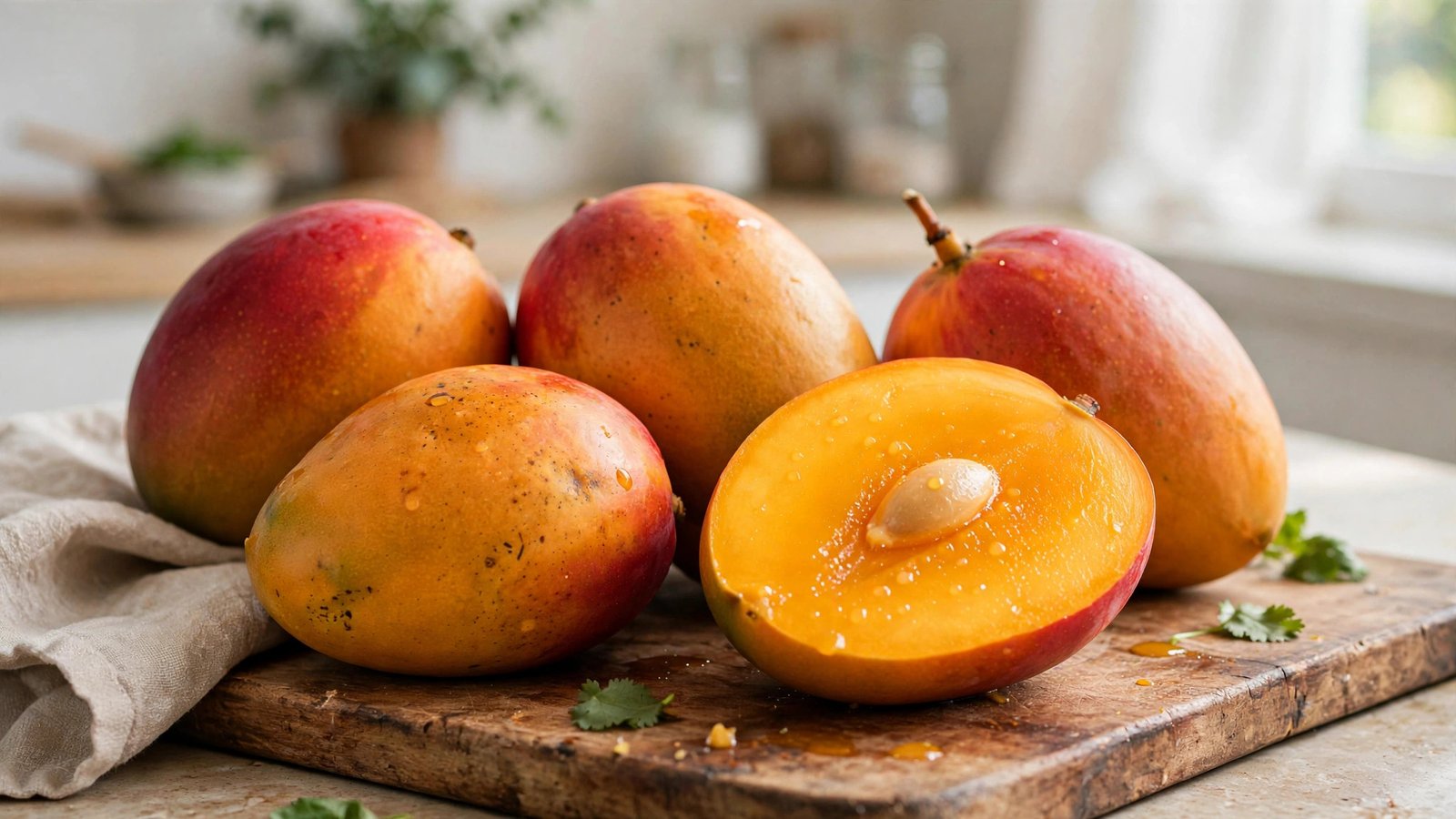
A ripe mango gives slightly when you press it gently — much like a ripe peach or avocado — and smells sweet and fragrant at the stem end. That is the whole test. Colour is a red herring: some perfectly ripe mangoes stay green, while some vividly red ones are still hard as cricket balls inside. Squeeze, sniff, and trust your senses over your eyes.
The squeeze test (the one that matters)
Cradle the mango in your palm and apply gentle, even pressure with your fingers — never poke it with your thumb, which bruises the flesh. A ripe mango yields softly and springs back. If it is rock hard, it needs more time. If it feels mushy or your fingers sink in, it is overripe: still fine for smoothies, but past its best for slicing.
The sniff test
Hold the mango up to your nose and smell the stem end, where the stalk was attached. A ripe mango smells sweet, fruity and almost floral. No smell at all means it is underripe; a sour or fermented, almost wine-like smell means it has gone too far. This test is remarkably reliable once you have tried it a couple of times.
What about colour and spots?
Mango colour tells you about the variety, not the ripeness. Alphonso mangoes ripen to a deep golden yellow; Tommy Atkins stay red-green even when perfectly ripe; Keitt mangoes remain green at peak ripeness. Ignore the blush. A few small dark spots or a slightly wrinkled skin are actually good signs on many varieties — they indicate the sugars have developed. But large black patches or oozing sap suggest rot, not ripeness.
How to ripen a hard mango at home
Bought a mango with the texture of a billiard ball? You can rescue it in a few days:
- Paper bag method (fastest): place the mango in a brown paper bag with a banana or apple. The ethylene gas they release speeds ripening to 1–3 days.
- Room temperature: leave it on the worktop out of direct sunlight; most mangoes ripen in 3–5 days.
- Never the fridge: cold halts ripening and damages the flavour. Only refrigerate once ripe, where it keeps for up to 5 days.
- Rice trick: burying a mango in dry rice is a traditional method that works, though the paper bag is less faff.
Once ripe, mangoes are wonderfully versatile — and if you are checking freshness across the fruit bowl, our guide to how to tell if steak is bad applies the same senses-first approach to meat, while how long bagels are good for covers bakery storage.
Mango varieties you’ll find in UK shops
Knowing the variety helps you judge ripeness, since each behaves differently:
- Alphonso: the connoisseur’s mango — small, golden-yellow when ripe, intensely fragrant and fibreless. In season roughly April–June.
- Kent: large, sweet and juicy with minimal fibre; ripens from green to yellow with a red blush.
- Tommy Atkins: the most common supermarket mango — red-blushed, firm and fibrous. Reliable rather than thrilling; judge by squeeze, not colour.
- Keitt: stays green even when fully ripe, which catches people out. Large and sweet with a hint of citrus.
- Honey (Ataulfo): small, kidney-shaped, deep golden and exceptionally sweet with almost no fibre.
Whatever the variety, the squeeze-and-sniff test never lies. And if you are buying in bulk for a party or a week of smoothies, buy a mix of ripe-now and ripen-later fruit so they don’t all peak on the same day.
Cutting a ripe mango
Stand the mango on its end and slice down either side of the flat central stone to free the two “cheeks”. Score the flesh in a criss-cross pattern without cutting through the skin, then push the skin inside-out to pop the cubes up — the classic hedgehog. Slide a knife under the cubes to release them. A ripe mango’s flesh should be sunset-orange, juicy and free of stringy fibres.
The BBC Good Food guide to cutting a mango has step-by-step photos, and Love Food Hate Waste offers UK-specific advice on storing fruit to cut waste.
FAQs
Should a mango be red to be ripe?
No. Red colouring is just variety blush — many ripe mangoes are green, gold or orange. Ripeness is judged by gentle give and a sweet smell at the stem end, never by colour alone.
How long does it take for a mango to ripen?
Typically 2–5 days at room temperature, or 1–3 days in a paper bag with a banana. Refrigeration stops the process, so keep unripe mangoes on the worktop.
Can you eat an overripe mango?
Yes, if it just smells very sweet and feels soft — blend it into smoothies, lassis or sorbet where texture doesn’t matter. Bin it if it smells fermented, alcoholic or sour.
How do you store a ripe mango?
In the fridge, where it keeps for up to 5 days. Cut mango should be sealed in an airtight container and eaten within 2–3 days. Ripe mango also freezes brilliantly in chunks for smoothies.