
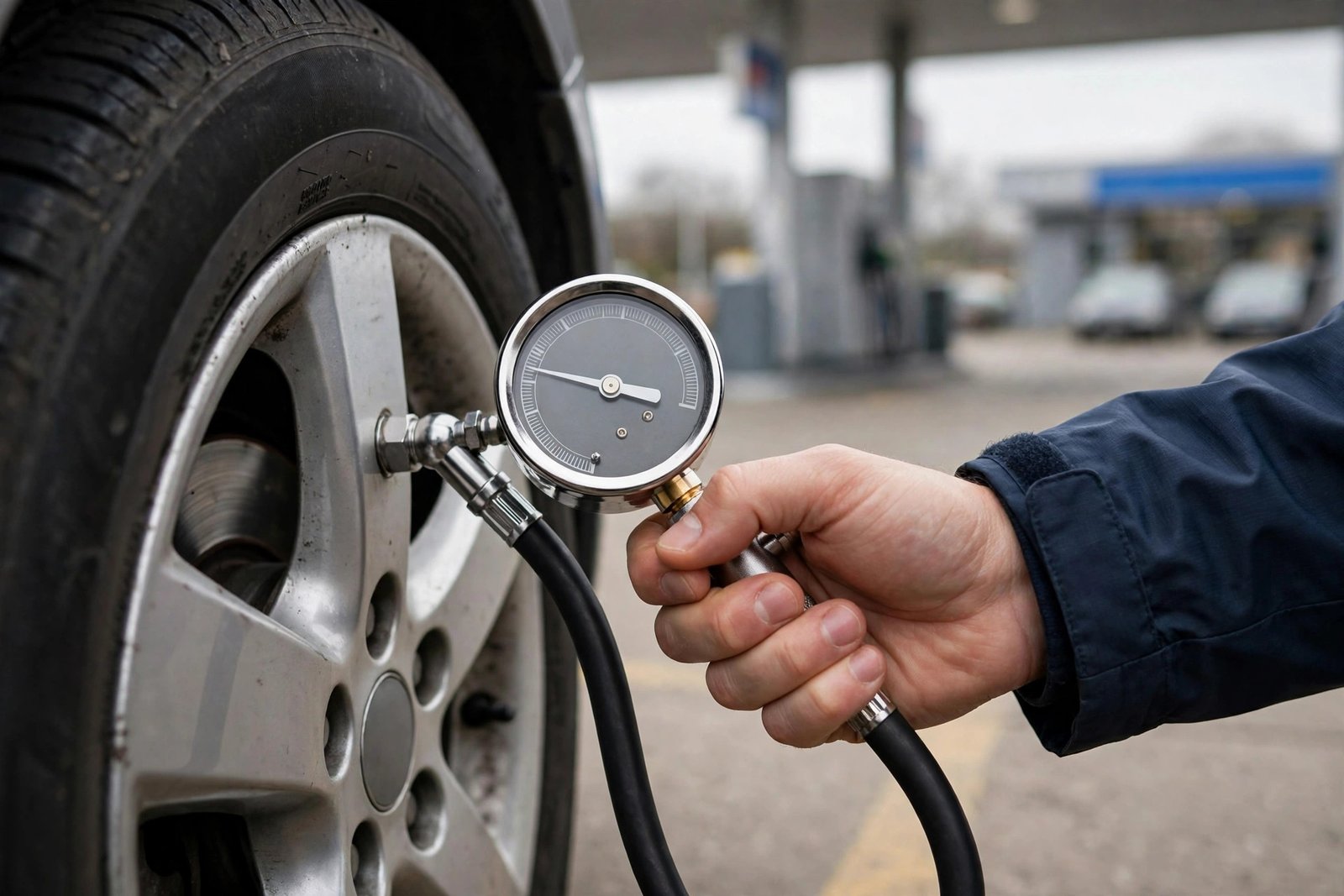
Two numbers on the side of your tyre and a dashboard light you’ve been ignoring — that’s the entire relationship most drivers have with tyre pressure. Yet those numbers quietly control how much fuel you burn, how safely you stop, and how long your tyres last. Under-inflated tyres are one of the most common and most wasteful car problems in Britain: millions of drivers are burning extra fuel every single day without knowing it. Here’s the complete beginner’s guide to understanding tyre pressure and fuel economy — no background knowledge required.
What Tyre Pressure Actually Does
Your tyres are the only part of the car touching the road — four contact patches roughly the size of your palms. Correct pressure keeps each patch the right shape: the tread sits flat, grip is even, and the tyre rolls efficiently. Get the pressure wrong and everything degrades.
Under-inflated tyres (too little air) sag, so more rubber drags on the road. This rolling resistance forces the engine to work harder — burning more fuel — while the tyre’s shoulders wear prematurely, handling gets vague, and in extreme cases the tyre overheats and fails. Over-inflated tyres bulge the opposite way: only the centre of the tread touches the road, reducing grip (especially in the wet), making the ride harsh, and wearing the middle of the tyre fast.
The sweet spot is set by your car’s manufacturer, not the tyre maker — it’s engineered for your specific vehicle’s weight and handling. Find it on the driver’s door jamb sticker, inside the fuel flap, or in the owner’s manual. Note there are usually two figures: normal load and full load (with passengers and luggage).
The Fuel Economy Connection: Real Numbers
Here’s the figure that converts sceptics: tyres just 10% under-inflated increase fuel consumption by roughly 2–3%, and severely under-inflated tyres (25% down, which is common) can waste 5% or more. For a driver covering 10,000 miles a year at 40mpg, that’s £60–£150 a year literally leaking into the air — plus faster tyre wear adding another £50–£100 in early replacements.
The physics is simple: soft tyres deform more with each rotation, and deforming rubber absorbs energy as heat. Your engine supplies that energy as extra fuel. It’s a tax you pay for not spending two minutes a month at the air pump — which, at most petrol stations, is free or £1.
If you’re weighing driving costs against alternatives, see how to save money on UK train travel and whether a railcard is worth it — sometimes the train wins once you count the true cost of driving.
How to Check and Adjust: The Two-Minute Routine
When: monthly, and before long journeys. Always check cold — before driving or at least three hours after — because driving heats the air and raises the reading by several PSI, giving a false high.
How: unscrew the valve cap, press the gauge firmly onto the valve, read the pressure. Compare with the manufacturer’s figure (in PSI or bar — 1 bar ≈ 14.5 PSI). Add air in short bursts, rechecking as you go; if you’ve overshot, press the valve pin to release a little. Replace the cap — it keeps dirt out of the valve.
Don’t forget the spare (if you have one) — a flat spare discovered at the roadside is a special kind of misery. And check pressures when seasons change: tyre pressure drops roughly 1 PSI for every 5–6°C temperature fall, so autumn always needs a top-up.
The gov.uk vehicle maintenance guidance covers your legal obligations, and both the RAC and AA publish clear tyre-safety explainers.
Beyond Pressure: The Other Fuel-Economy Levers
Tyre pressure is the easiest win, but it’s one of several. Tyre choice: EU tyre labels rate fuel efficiency A–E — A-rated tyres can save meaningful fuel over E-rated ones, worth considering at replacement time. Wheel alignment: misaligned wheels drag sideways, wasting fuel and chewing tyres; get it checked if the car pulls or tyres wear unevenly. Weight: every 50kg of junk in the boot costs ~1–2% in fuel — clear it out. Roof boxes and bars: ruin aerodynamics; remove them when not in use and save up to 10% on motorway journeys.
Driving style dwarfs all of these: smooth acceleration, anticipating traffic to avoid braking, and cruising at 60–65mph instead of 75–80mph can cut fuel use by 15–25%. The most fuel-efficient car is the one driven gently — and gentle driving also halves brake and tyre wear.
Warning Signs Your Tyres Need Attention
Check monthly for: uneven wear (edges worn = under-inflation; centre worn = over-inflation; one-sided = alignment), cracks or bulges in the sidewall (bulges mean internal damage — replace immediately), tread depth (legal minimum 1.6mm across the central three-quarters, but grip drops sharply below 3mm — the 20p test: insert a 20p coin; if the outer band is visible, change them), and age (tyres degrade with time; over 5–6 years old deserves professional inspection regardless of tread).
That dashboard TPMS light (the exclamation mark in a horseshoe) means check pressures now — but note it only warns at ~25% under-inflation, long after fuel waste began. Don’t wait for the light; the monthly check catches problems months earlier.
Conclusion
Tyre pressure is the highest-ROI maintenance in motoring: two minutes a month saves £100+ a year in fuel, extends tyre life, sharpens handling, and keeps you legal. Check cold, match the manufacturer’s figures, mind the seasons, and drive smoothly. Your wallet, your tyres, and everyone sharing the road with you will be better off.
Frequently Asked Questions
What PSI should my tyres be?
Whatever your car’s manufacturer specifies — check the driver’s door jamb sticker, fuel flap, or owner’s manual. There’s no universal figure; it varies by vehicle, and there are usually separate figures for normal and fully-loaded conditions.
How often should I check tyre pressure?
Monthly, plus before long journeys and when seasons change (pressure drops ~1 PSI per 5–6°C of cooling). Always check when tyres are cold for an accurate reading.
Is it illegal to drive with under-inflated tyres?
Driving with tyres in a dangerous condition — which can include severe under-inflation — can earn 3 penalty points per tyre and fines. More importantly, it dramatically increases blowout and accident risk.
Do fuel-efficient tyres really make a difference?
Yes — the EU label’s A-to-E fuel efficiency rating reflects real rolling-resistance differences. Moving from E to A rated tyres can improve economy by several percent, which compounds over the tyre’s life.
Why does my TPMS light keep coming on in winter?
Cold air contracts — pressure drops about 1 PSI per 5–6°C. Autumn’s first cold snap routinely triggers TPMS warnings. Top up to the correct cold pressure and the light should clear; if it persists, check for a slow puncture.
Can wrong tyre pressure cause an MOT failure?
Not directly — the MOT doesn’t measure pressure. But the damage wrong pressure causes does fail tests: uneven or excessive tread wear, sidewall bulges, and cuts from running soft all count as failures. Correct pressure is preventive maintenance for your MOT.
Should I inflate tyres to the maximum shown on the sidewall?
No — the sidewall figure is the tyre’s maximum safe pressure, not your car’s recommended pressure. Always use the vehicle manufacturer’s figure from the door jamb or manual; the sidewall maximum is a safety limit, not a target.