You’re driving along when an unfamiliar symbol lights up on the dashboard — an exclamation mark in a horseshoe? A little engine silhouette glowing amber? Your stomach drops. Is the car about to explode, or is it telling you the washer fluid is low? Dashboard warning lights are your car’s language, and most British drivers are only semi-fluent. Misreading them ranges from harmless (panic over nothing) to catastrophic (driving on with a red oil light and destroying the engine). Here’s how to understand every dashboard warning light in England — what the colours mean, which symbols matter, and exactly what to do.
The Colour Code: Red, Amber, Green, Blue
Before learning individual symbols, learn the colours — they tell you the urgency instantly:
Red = stop. A red light means something needs immediate attention — stop safely as soon as possible and don’t continue driving until you understand it. Red oil pressure, red coolant temperature, red brake warnings: these are “pull over now” lights. Driving on can destroy the engine or leave you without brakes.
Amber/yellow = caution. Something needs attention soon — check it at the next safe opportunity and book diagnosis promptly. Amber engine management, TPMS (tyre pressure), ABS warnings: the car is drivable, but the issue won’t fix itself and may worsen.
Green/blue = information. These just tell you a system’s active — headlights, indicators, cruise control, full beam (blue). No action needed; they’re the dashboard making conversation.
This single framework resolves 80% of dashboard anxiety: red means stop, amber means soon, green/blue means relax.
The Red Lights You Must Never Ignore
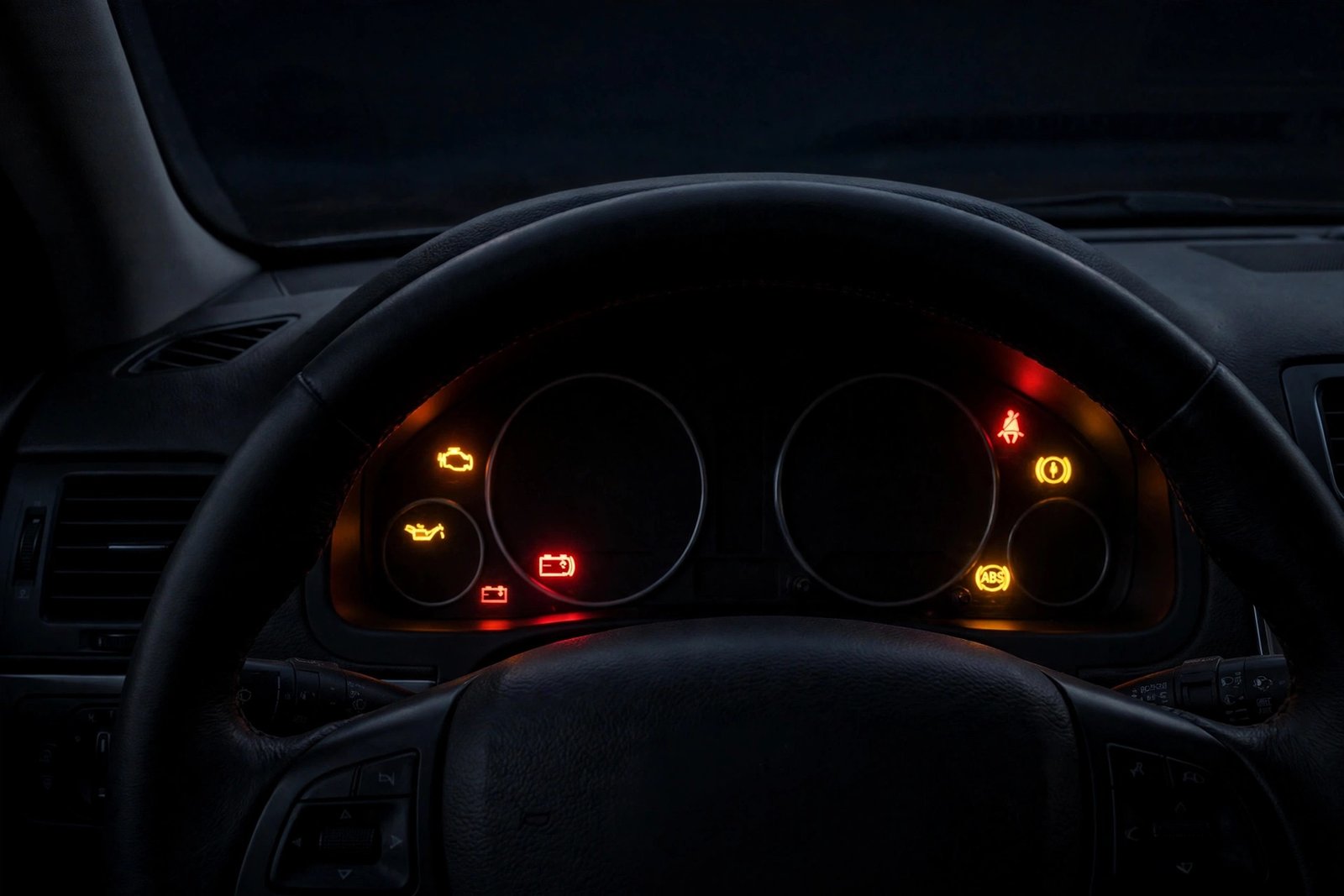
Oil pressure (oil can symbol): the engine isn’t getting oil pressure — continuing to drive can seize the engine in minutes, a £3,000+ catastrophe. Stop immediately, check oil level once cooled, and call for recovery if the light persists. This is the most expensive light to ignore.
Coolant temperature (thermometer in waves): the engine is overheating. Stop, let it cool (never open a hot radiator cap — scalding risk), check coolant level when cool. Driving an overheating engine warps the cylinder head.
Brake system (exclamation in a circle, or “BRAKE”): could be the handbrake left on (embarrassing, harmless) or brake fluid loss / system failure (terrifying, dangerous). If the handbrake is off and the light stays on, stop — do not drive with compromised brakes.
Battery/charging (battery symbol): the alternator isn’t charging — you’re running on battery alone, which lasts 20–30 minutes. Turn off everything electrical (heated screens, blowers, lights if safe) and get to a garage or safe stopping point before the car dies completely.
Airbag/SRS: the airbag system has a fault — airbags may not deploy in a crash. Drive cautiously to a garage; this needs professional diagnosis.
The Amber Lights You’ll See Most Often
Engine management / check engine (engine silhouette): the most common amber light — it means the engine computer detected something out of range, from a loose fuel cap to a failing sensor. If it’s flashing, that’s urgent (usually a misfire damaging the catalytic converter — reduce speed and get diagnosed promptly). If steady, book diagnosis within days. A £30 OBD-II scanner (bought carefully — see how to check if a website is safe to buy from) reads the fault code and tells you roughly what’s wrong before you visit a garage.
TPMS (exclamation in a horseshoe): tyre pressure low — check and inflate all tyres (including the spare’s existence in your mind) at the next stop. It triggers at ~25% under-inflation, so don’t wait for it as your pressure gauge.
ABS: anti-lock braking has a fault — normal brakes still work, but emergency stops may lock wheels. Drivable with care; get it fixed.
Traction/stability control (skidding car): flashing during slippery driving is normal (it’s working); staying on constantly means the system is off or faulty.
Diesel particulate filter (exhaust with dots): the DPF needs a regeneration run — typically 15+ minutes of sustained higher-speed driving. Ignoring it clogs the filter, a £1,000+ replacement. If you only do short trips, this light is your car begging for a lifestyle change (or a petrol car).
Lights Specific to Modern Cars
Newer cars add layers: AdBlue warnings (diesels — top up the fluid; ignoring it eventually prevents the car starting), lane-keeping and autonomous braking warnings (usually just informing you the system intervened or is unavailable due to dirty sensors — clean the windscreen cameras), tyre pressure per-wheel displays, service reminders (spanner symbol — maintenance due, not a fault), and EV-specific lights (battery temperature, charging faults, reduced power mode).
Your owner’s manual has the definitive symbol glossary for your exact model — the 10 minutes spent reading the dashboard section pays for itself the first time a mystery light appears at night on the motorway.
What to Do: The Decision Tree
Red light: stop safely as soon as possible. Check the obvious (oil, coolant when cool, handbrake). If in doubt, call breakdown recovery — that’s what it’s for. Never “see if it goes away” with a red light.
Flashing amber: treat like red — reduce speed, minimise load, get professional diagnosis promptly.
Steady amber: continue cautiously, avoid hard driving, book diagnosis within days. Note any symptoms (noises, performance changes, smells) to tell the garage — symptoms plus the light make diagnosis faster and cheaper.
Any light + symptoms (smoke, smells, noises, handling changes): escalate one level — amber with symptoms gets red-light treatment.
Before long trips — especially long family car journeys — do a dashboard check at startup: all warning lights should illuminate briefly then extinguish. Any that stay on need addressing before you load the kids and set off.
Conclusion
Dashboard warning lights are simpler than they look: red means stop now, amber means fix soon, green and blue are just information. Learn the five critical reds (oil, coolant, brakes, battery, airbag) by heart, treat flashing ambers as urgent, and never ignore symptoms accompanying any light. Your car is talking to you — fluency takes an afternoon to learn and saves you from both panic and catastrophe. The most expensive dashboard light is the one you didn’t understand, so keep the gov.uk MOT guidance bookmarked, check the RAC’s dashboard-light explainer for your specific symbols, and consult the AA’s advice if a light appears mid-journey.
Frequently Asked Questions
Can I drive with the check engine light on?
If it’s steady and the car drives normally, yes — cautiously, to a garage within days. If it’s flashing, or accompanied by symptoms (misfiring, smoke, power loss), reduce speed and get diagnosis urgently — flashing usually means catalytic converter damage is occurring.
What does the horseshoe warning light mean?
That’s the TPMS (tyre pressure monitoring) light — one or more tyres is significantly under-inflated. Check all pressures at the next stop and inflate to the manufacturer’s figures. Don’t use it as your routine gauge; it only warns at ~25% under.
Why do all the lights come on when I start the car?
That’s the self-test — every warning light illuminates briefly to prove its bulb works, then should extinguish. Any light that stays on after starting indicates a real issue needing attention.
Will a warning light fail my MOT?
Yes, for certain lights — an illuminated engine management light, ABS warning, airbag/SRS light, or TPMS light are MOT failures. The tester checks that warning lights illuminate and extinguish correctly during the test sequence.
Should I buy an OBD-II scanner?
For the car-curious, yes — a £20–£40 Bluetooth scanner plus a phone app reads fault codes and demystifies amber warnings before garage visits. It won’t fix anything, but arriving at the garage knowing the fault code makes you an informed customer rather than a captive one.