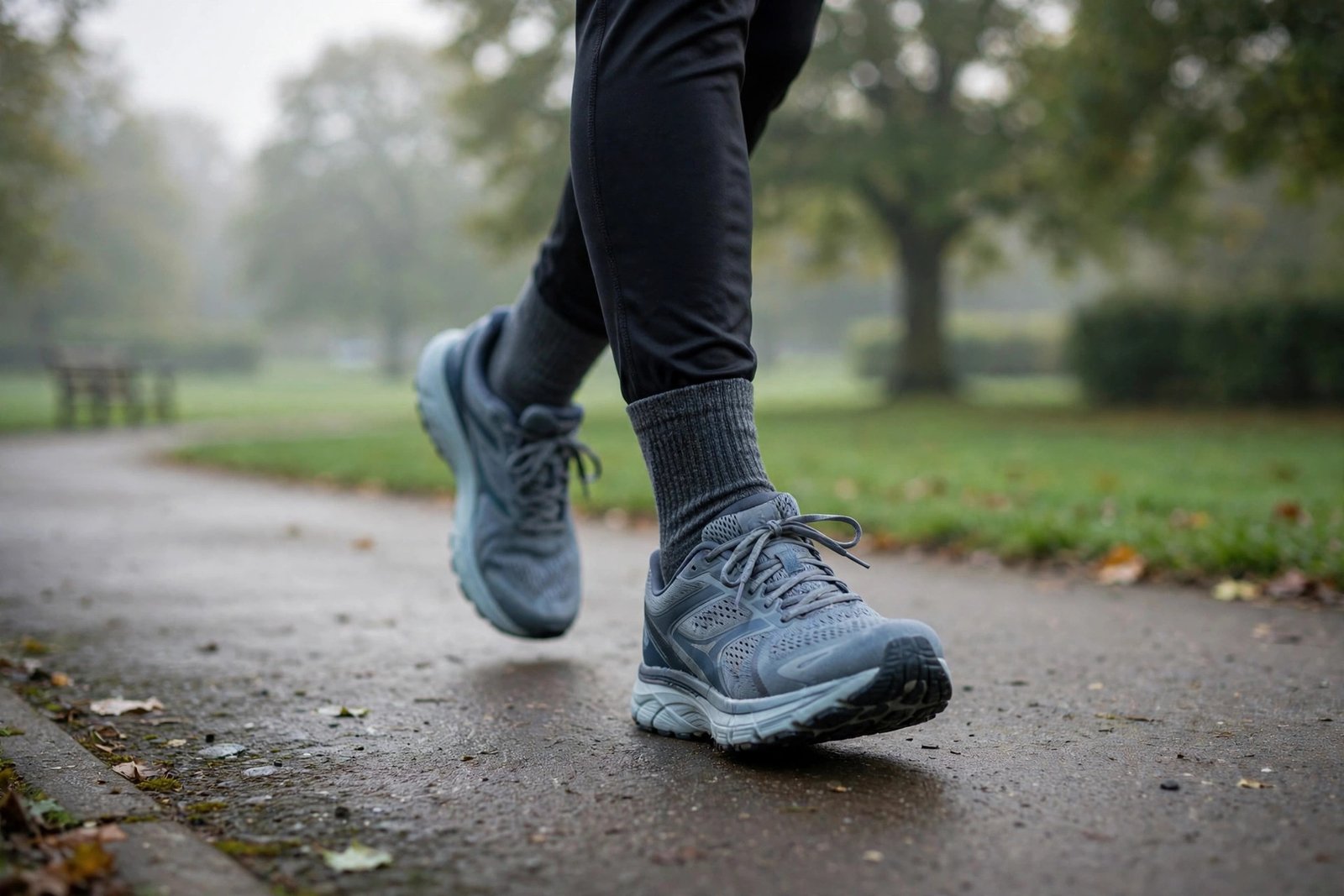
If you have flat feet and you’ve ever bought running shoes based on how they looked on the shelf, you’ve probably paid for that mistake in aching arches, sore knees, or shin splints that arrive like clockwork three weeks into a new routine. Choosing the right running shoes for flat feet in England isn’t about picking the most expensive pair — it’s about understanding how your feet actually move when you run, and matching that movement to the right category of shoe. Get this right and running becomes comfortable; get it wrong and every run feels like a punishment.
In this guide, you’ll learn what flat feet mean for a runner, how to tell whether you overpronate, which features genuinely matter (and which are marketing fluff), and a practical step-by-step method for buying your next pair — whether you’re shopping in a specialist running shop in Manchester or ordering online from your sofa in Norwich.
What Flat Feet Actually Do When You Run
Flat feet — low or collapsed arches — mean your foot tends to roll inwards more than average when it lands. This inward roll is called pronation, and a certain amount of it is completely normal. The trouble starts with overpronation, where the roll is excessive and the ankle collapses inward on every stride.
Overpronation sends a chain reaction up your legs: the ankle tilts, the shin rotates, the knee tracks inward, and the hips compensate. That’s why flat-footed runners so often develop runner’s knee, Achilles tendinopathy, plantar fasciitis, and shin splints. The shoes can’t fix your anatomy, but the right pair can guide your foot into a more neutral position and absorb the forces your arches aren’t handling.
One important myth to clear up: flat feet are not a sentence to a life of heavy, clunky “orthopaedic” shoes. Modern stability shoes look and feel like normal trainers. The category has moved on enormously in the last decade.
Step 1: Find Out How Much You Overpronate
Before spending a penny, get a sense of your gait. The gold standard is a gait analysis at a specialist running shop — available in most English cities, usually free if you buy shoes there, and taking about fifteen minutes. You run briefly on a treadmill while a camera films your feet in slow motion, and a trained fitter watches exactly where your ankle goes at landing.
If you’d rather start at home, try the wet test: wet the sole of your foot, step onto a brown paper bag, and look at the footprint. A flat foot leaves a nearly complete print with little inward curve. Then check the wear pattern on your current trainers — heavy wear along the inside edge of the heel and forefoot is the classic overpronator signature.
Be honest about your running too. A shoe that suits a 20-mile-a-week marathon trainee may be overkill for someone jogging twice a week round the local park. Your fitter will ask about mileage, surfaces, and injury history — all of it matters.
Step 2: Know the Three Shoe Categories
Running shoes broadly fall into three stability categories, and flat-footed runners live in the middle one:
Neutral shoes
Built for runners whose feet roll normally. They offer cushioning but no corrective structure. If you genuinely overpronate, neutral shoes will let your ankle collapse unchecked — this is the most common buying mistake flat-footed runners make.
Stability shoes
The sweet spot for most flat feet. They include guidance features — denser foam on the inside edge of the midsole, a structured heel counter, sometimes a plastic shank — that slow the inward roll without forcing your foot into an unnatural position. Think of them as gentle guardrails rather than a straitjacket.
Motion-control shoes
The firmest option, designed for severe overpronation or heavier runners. They’re heavier and stiffer, and honestly, fewer runners need them than shops used to claim. Start with stability and only step up if a fitter advises it.
The Features That Genuinely Matter
Cut through the jargon and focus on these:
Arch support that matches your foot, not a generic bump. The arch structure should sit comfortably under your own arch. If it digs in or feels like a golf ball under your foot in the shop, it won’t improve on a run.
A firm heel counter. Squeeze the back of the shoe — it should resist collapsing. A solid heel cup keeps your rearfoot aligned at the moment of impact, which is where overpronation starts.
Appropriate cushioning, not maximum cushioning. Very soft, thick midsoles feel luxurious standing still but can feel unstable for overpronators, because the foot sinks and rolls. Look for a balance: responsive foam with a stable base.
The right width. Flat feet often splay wider under load. Many brands offer wide fittings — use them. A shoe that’s too narrow will squeeze your forefoot and make pronation worse, however good the stability features are.
Enough room in the toe box. You want roughly a thumb’s width between your longest toe and the end of the shoe. Feet swell on longer runs, and cramped toes change how you land.
When to Consider Insoles or Orthotics
Off-the-shelf stability shoes handle mild to moderate overpronation well. But if you’ve had recurring injuries, or a physiotherapist has flagged significant biomechanical issues, custom orthotics prescribed after a proper assessment can be transformative. A halfway option is a quality aftermarket insole, which adds arch support to a neutral shoe — though for most flat-footed runners, a well-chosen stability shoe makes separate insoles unnecessary.
If you’re starting running as a complete beginner over 40, getting footwear right from day one matters even more, because older joints are less forgiving of bad mechanics. And once you’ve found your pair, learn how to stop new shoes from giving you blisters so the break-in period doesn’t derail your first month.
Shopping Smart: In-Store vs Online
In-store gait analysis remains the best route for flat-footed runners buying their first proper pair. You’ll try shoes you would never have picked, and the fitter will spot things — like one foot pronating more than the other — that no product description reveals.
Buying online works well for replacements once you know your model and size. Stick to retailers with free returns, and test shoes indoors on carpet first. Run up and down your hallway, not just stand in them — problems show up in motion. For trustworthy guidance on buying footwear safely over the internet, the NHS advice on flat feet is a solid starting point, and the NHS beginner’s running tips cover building up mileage without injury.
How Often to Replace Them
Running shoes lose their supportive structure long before they look worn out — typically after 300 to 500 miles. For a flat-footed runner, a dead shoe is worse than no guidance at all, because collapsed foam can actually exaggerate the inward roll. Track your mileage with a free app, and rotate two pairs if you run regularly; alternating pairs extends each one’s life and gives your feet slightly different stimuli.
Conclusion
Choosing running shoes for flat feet comes down to a simple sequence: understand your gait, shop in the stability category, prioritise fit and heel control over marketing features, and replace shoes before the support dies. Do that, and flat feet become a footnote in your running story rather than the headline. The best shoe is not the most expensive or the most cushioned — it’s the one that keeps your particular feet moving in a straight, comfortable line, mile after mile.
Frequently Asked Questions
Can flat-footed people run comfortably at all?
Absolutely. Millions of runners have flat feet. With the right stability shoes — and sensible mileage increases — flat feet rarely limit anyone. Problems come from wrong footwear, not from the feet themselves.
Do I need custom orthotics, or are stability shoes enough?
For most mild-to-moderate overpronators, a good stability shoe is enough. Consider custom orthotics if you have recurring injuries, significant asymmetry between feet, or a physio’s recommendation after assessment.
Are expensive running shoes better for flat feet?
Not necessarily. Price often reflects weight-saving tech and premium foams aimed at racers. A mid-range stability shoe that fits your gait beats a £200 neutral racer every time for a flat-footed runner.
Should I buy shoes a size bigger for running?
Buy by fit, not by rule. You need about a thumb’s width of space ahead of your longest toe, but going too big causes sliding and blisters. Get fitted late in the day when feet are slightly swollen.
Can I use my flat-feet running shoes for the gym?
For treadmill running, yes. For heavy weightlifting, a flat, stable sole is safer than a cushioned runner. Many people keep separate pairs — it’s worth it if you do both regularly.