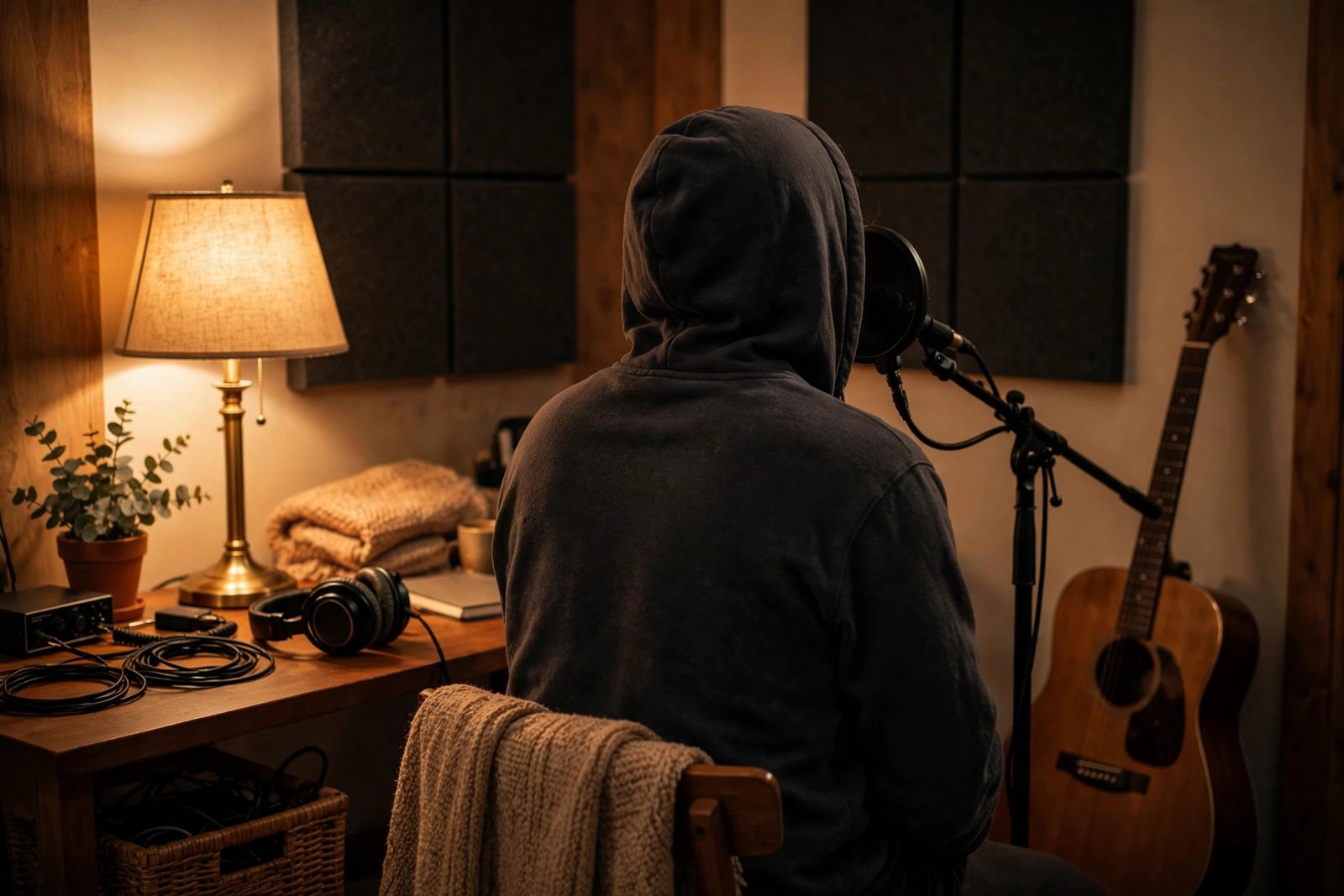
Can you learn to sing without formal lessons? Ask a vocal coach and you might get a withering look — but ask the thousands of self-taught singers uploading covers from their bedrooms and you’ll get a different answer. In 2026, with structured online resources, pitch-analysis apps, and recording tools in every pocket, learning to sing on your own is more feasible than at any point in history. Formal lessons help, but they’re not the gatekeeper they once were.
This guide lays out a complete self-teaching path: what to work on, in what order, and how to avoid the bad habits that make coaches wince.
The Honest Truth About “Tone Deafness”
Let’s kill the biggest myth first: true tone deafness (amusia) affects roughly 4% of the population. Almost everyone who says “I can’t sing” can actually hear pitch differences just fine — what they lack is the coordination between ear and vocal muscles. That’s trainable. If you can tell when someone sings out of tune, your ear works; your voice just hasn’t learned to follow instructions yet.
The second myth: that good singers are born. Voice science is clear — singing is a motor skill like any other, built through deliberate practice. Some people start with better natural coordination, but the gap closes with training. What you need isn’t talent; it’s a practice routine and feedback loops.
Phase 1: Foundations (Weeks 1–4)
Breathing: the engine of everything
Singing runs on breath support, not throat muscle. Practice diaphragmatic breathing daily: lie down with a book on your belly, breathe so the book rises while your chest stays still. Then practise hissing out on a steady “ssss” for as long as possible — aim to extend from 15 seconds toward 30+. This single exercise, done five minutes daily, transforms vocal stability within weeks.
Posture and release
Stand (or sit) tall, shoulders relaxed, jaw unclenched, tongue resting loosely. Tension is the beginner singer’s enemy — a tight jaw or raised shoulders strangles tone. Shake out your shoulders, do exaggerated yawns to open the throat, and hum gently for a few minutes before any singing. Boring? Yes. Effective? Completely.
Finding your range
Using a free piano app, slide from your lowest comfortable note to your highest on a hum. Most untrained adults have about an octave and a half of usable range. Knowing your range stops you torturing yourself with songs written for voices nothing like yours — the number-one cause of beginner frustration and vocal strain.
Phase 2: Pitch and Ear Training (Ongoing)
This is the core skill, and it’s where 2026’s tools shine:
- Pitch apps: Apps like Vocal Pitch Monitor, Sing Sharp, or Perfect Piano show your pitch in real time — you see the note drift flat and correct it. This visual feedback loop is the closest thing to having a coach’s ear, and it’s free.
- Matching exercises: Play a note on a piano app, sing it back, check the app. Start with single notes, then intervals (do-mi, do-sol), then short phrases. Ten minutes daily.
- Sing along — then sing alone: Learn songs singing along with recordings, then try them a cappella with a pitch app running. The gap between the two shows you exactly what needs work.
- Record everything: Your phone’s voice memos are brutally honest in a way your skull resonance isn’t (you hear yourself differently from inside your head). Weekly recordings are your progress diary — compare month one to month three and the improvement will shock you.
When you’re ready to capture those recordings properly, see our guide to discovering new music beyond the charts for repertoire ideas — singing songs you love, across genres, builds versatility faster than drilling one style.
Phase 3: Technique Building (Months 2–6)
Warm-ups that aren’t a waste of time
Five to ten minutes before singing: lip trills (brrr through the lips) sliding up and down your range, sirens on “ng” (like the end of “sing”), and gentle scales on “mee-may-mah-moh-moo.” Lip trills deserve special mention — they balance breath pressure automatically and are nearly impossible to do harmfully, making them the safest beginner exercise in existence.
Vowels and resonance
Beginners sing words; singers sing vowels. Practise sustaining pure vowels (ah, eh, ee, oh, oo) on single pitches, aiming for a consistent, ringing tone. Then sing song lyrics slowly, exaggerating the vowels. This one shift — thinking in vowels — is what separates “person singing along” from “singer” to a listener’s ear.
Expanding range safely
Extend your range with gentle sirens a semitone beyond your comfortable top, then back down — never push, never strain. Range grows like flexibility: gradually, with consistent gentle stretching. If your throat hurts, stop. Hoarseness after practice means you overdid it; adjust tomorrow.
The Resources That Replace Lessons
- YouTube vocal coaches: Channels like New York Vocal Coaching and VoiceHacks offer structured free content rivalling paid courses. Find one teacher whose explanations click and follow their beginner series in order — don’t hop between ten coaches.
- Structured apps: Vanido and Singing Carrots provide daily exercises with feedback. The free tiers are genuinely useful.
- Choirs and singing groups: The secret weapon of self-taught singers. Community choirs across the UK welcome beginners, cost little (£5–£10 a session or less), and provide the two things apps can’t: blending with other voices and a conductor’s ear. Search “community choir near me” — there’s almost certainly one within reach.
- Open mics: When you’re ready, finding free gigs and open mic nights gives you performance experience — the final skill no bedroom practice teaches.
Bad Habits to Avoid (What Coaches Wish You Knew)
- Singing through pain: Discomfort is information. Pushing through hoarseness risks vocal nodules — small calluses on the vocal cords that can require therapy or surgery. Rest is training.
- Imitating one idol exclusively: Copying Adele’s or Ed Sheeran’s exact sound forces your voice into shapes it wasn’t built for. Learn from singers; don’t become them.
- Skipping warm-ups: The vocal cords are muscles. You wouldn’t sprint without warming up your legs.
- Only singing full songs: Athletes drill; singers should too. Isolate the hard phrase, loop it slowly, then reintegrate. Running the whole song repeatedly just rehearses the mistakes.
- Dehydration and shouting: Drink water, warm up before nights out, and don’t scream over club noise — lifestyle vocal abuse undoes practice gains. The British Voice Association offers excellent free guidance on vocal health.
When to Consider Even One Lesson
Self-teaching has a ceiling: you can’t hear your own tension, and some habits need outside ears. A single diagnostic lesson (£30–£60 for an hour with a qualified teacher — check the Musicians’ Union or local teacher directories) every few months can catch problems you’d never spot. Think of it as an MOT, not a commitment. Many teachers offer one-off sessions happily.
Conclusion
You can absolutely learn to sing without formal lessons in 2026 — the tools, knowledge, and communities exist for the self-directed learner. The formula: daily breath work, pitch training with app feedback, structured warm-ups, vowel-focused technique, regular recording, and eventually a choir or open mic for real-world experience. Progress won’t be linear — expect plateaus around month two and breakthroughs around month four. But a year of consistent, smart practice will take almost anyone from “I can’t sing” to “wait, you learned that on your own?” And that moment is worth every lip trill.
Frequently Asked Questions
Can adults learn to sing from scratch?
Yes. Singing is a trainable motor skill, not a genetic gift — true tone deafness affects only about 4% of people. Adults often progress faster than children because they practise deliberately and understand the mechanics.
How long does it take to learn to sing well on your own?
Expect noticeable improvement in 6–8 weeks of daily practice, solid beginner-to-intermediate ability in 6 months, and genuine competence within a year. Consistency matters far more than session length — 20 focused minutes daily beats two hours on Sundays.
What is the best app for learning to sing?
For pitch feedback: Vocal Pitch Monitor or Sing Sharp. For structured exercises: Vanido or Singing Carrots (generous free tiers). For repertoire and learning songs: a piano app plus YouTube vocal coaches. No single app replaces all of them.
Do I need singing lessons or can YouTube teach me?
YouTube and apps can take you remarkably far — most technique is learnable from good structured content. The main thing lessons add is personalised diagnosis of tension and bad habits you can’t hear yourself. Consider an occasional one-off lesson as a check-up.
How do I stop singing out of tune?
Use a real-time pitch app while practising, do daily pitch-matching exercises (play a note, sing it back), record yourself to hear what listeners hear, and work on breath support — most pitch problems are actually breath problems in disguise.