
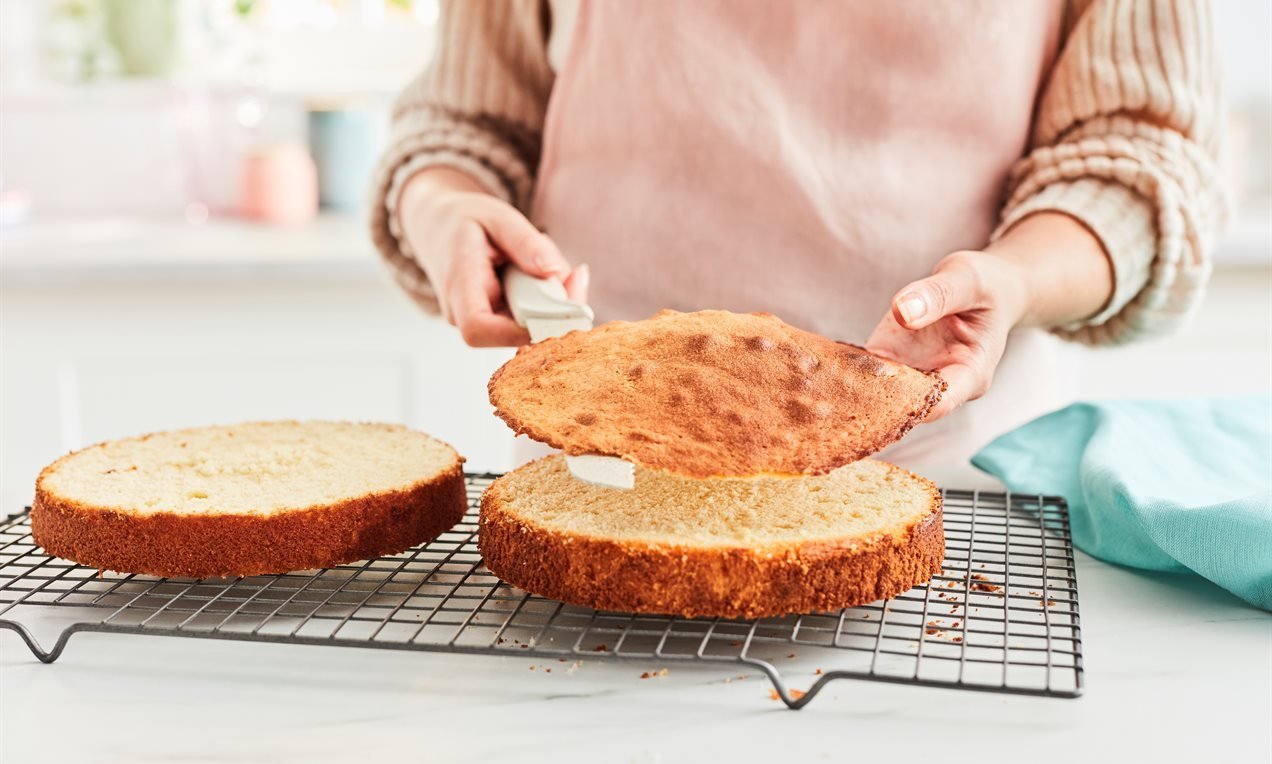
There’s nothing wrong with a domed cake’s flavour, but try stacking one into a layer cake and you’ll understand the frustration. The peaked middle has to be sliced off, which wastes cake, and the layers never sit quite level. If you want to stop cakes from doming and get those flat, professional-looking tops straight from the oven, the fix is simpler than most people expect.
I used to just accept the dome and slice it off — the baker’s tax, eaten warm with butter. But once I understood why doming happens, I realised it’s almost entirely about oven temperature and tin preparation. Here’s the science in plain English, plus every method that actually works, ranked from easiest to most faff.
Why cakes dome in the first place
A cake domes because the outside bakes faster than the inside. The batter at the edges of the tin is closest to the heat, so it sets and firms up first, forming a sort of rigid ring. The centre, still liquid, keeps rising as the raising agents do their work — and with nowhere else to go, it pushes upward into a dome. The hotter your oven, the bigger the difference between edge and centre, and the more dramatic the peak.
This is why doming and cakes sinking in the middle are mirror-image problems: sinking usually means the oven was too cool or the cake underbaked, while doming usually means the oven was too hot. Both come down to heat management. An oven thermometer is the single most useful £5 you’ll spend on baking — most domestic ovens run 10–20°C off the dial, and you can’t fix what you can’t measure.
How to stop cakes from doming: the methods that work
These are ordered by effort. Start at the top; most bakers never need to go past number two.
- 1. Lower the temperature, lengthen the bake. Drop the oven by 10–15°C from what the recipe says and add 5–10 minutes to the time. Gentler heat lets the centre and edges bake more evenly, so the whole cake rises at the same rate. This single change fixes mild doming for most people.
- 2. Use baking strips. These are strips of fabric (old tea towels work) soaked in water, wrung out, and wrapped around the outside of the tin, pinned or tied in place. They insulate the edges so they bake at the same pace as the centre. You can buy proper silicone baking strips for a few pounds, but a folded, damp tea towel secured with a safety pin does the same job. This is the professional bakery method, and it’s remarkably effective.
- 3. Don’t overfill the tin. Fill tins no more than two-thirds full — half is even better for layer cakes. Deep batter means the centre has further to bake through, which exaggerates the edge-centre gap. If you have too much batter, use a third tin rather than overfilling two.
- 4. Level the batter with a slight hollow. Before baking, smooth the batter and make a shallow dip in the centre with the back of a spoon. As the middle rises more than the edges, it fills the dip and levels out. It sounds too simple to work, but it genuinely helps with mild doming.
- 5. Check your tin colour and material. Dark, thin tins absorb more heat and bake the edges faster — a known dome-maker. Light-coloured aluminium tins bake more evenly. If all you have are dark non-stick tins, drop the temperature by 10°C as compensation.
What about the centre heating core trick?
For very deep cakes — anything over 20cm wide or celebration cakes with lots of batter — professionals sometimes use a heating core: a greased metal cone (or an upside-down flower nail) placed in the centre of the tin before the batter goes in. It conducts heat into the middle of the cake so the centre bakes as fast as the edges. It’s overkill for a standard Victoria sandwich, but if you’re baking big birthday cakes regularly, a £3 flower nail from a cake decorating shop is a neat trick.
Similarly, some bakers swear by baking at a lower temperature for the first half and then raising it — but honestly, a steady lower temperature throughout is simpler and just as effective. Don’t overcomplicate it.
- A note on fan ovens: fan ovens bake hotter and faster than the dial suggests, and they’re notorious dome-makers. If your recipe was written for a conventional oven, reduce by 20°C for fan (not the usual 10°C people quote) when doming is a problem. And always bake on the middle shelf — too high and the top sets before the middle has risen.
If it still domes: the honest fallback
Sometimes, despite everything, you get a slight dome — old ovens with fierce top elements are the usual reason. In that case, do what every professional does: level it. Let the cake cool completely, then slice the dome off with a long serrated knife, keeping the blade level. The trimmings are the baker’s perk.
A levelled cake ices and stacks exactly like a flat-baked one, so this isn’t failure — it’s standard practice. The methods above just mean you level less often and waste less cake. And if you’re assembling a Victoria sponge like a pro, place the levelled side down so the flat baked base becomes your perfect top. BBC Good Food’s baking tips covers tin preparation along similar lines if you want a second opinion.
Baking strips: DIY vs shop-bought
Since baking strips are the single most effective anti-dome tool, they’re worth a closer look. Shop-bought strips — silicone or fabric, from brands like Wilton or PME — cost £5 to £10 for a set, are washable, and come with Velcro or ties. They work by the same principle as the DIY version: a wet layer around the tin that keeps the edges cool while the centre catches up.
The DIY version is genuinely just as good: cut an old (clean) tea towel into strips about 8cm wide and long enough to wrap your tin, soak in cold water, wring until damp rather than dripping, wrap around the tin and pin with a safety pin or tie with string. Re-wet between batches if you’re baking several cakes. The only real advantage of shop-bought is convenience and not sacrificing tea towels.
One caution: don’t use strips on very shallow tins or for thin batters like brownies — they can slow the edges so much the outside underbakes. Strips are for proper cakes, 4cm of batter or deeper, where the edge-centre gap is the problem. For everyday sandwich tins, the lower-temperature method alone is usually enough, and strips are your upgrade for celebration cakes and wedding tiers.
The bottom line: To stop cakes from doming, bake 10–15°C cooler for a little longer, wrap the tins in damp baking strips, and don’t overfill. Those three changes fix it for nearly everyone — and on the rare occasions a dome still appears, a serrated knife and a cool head finish the job.