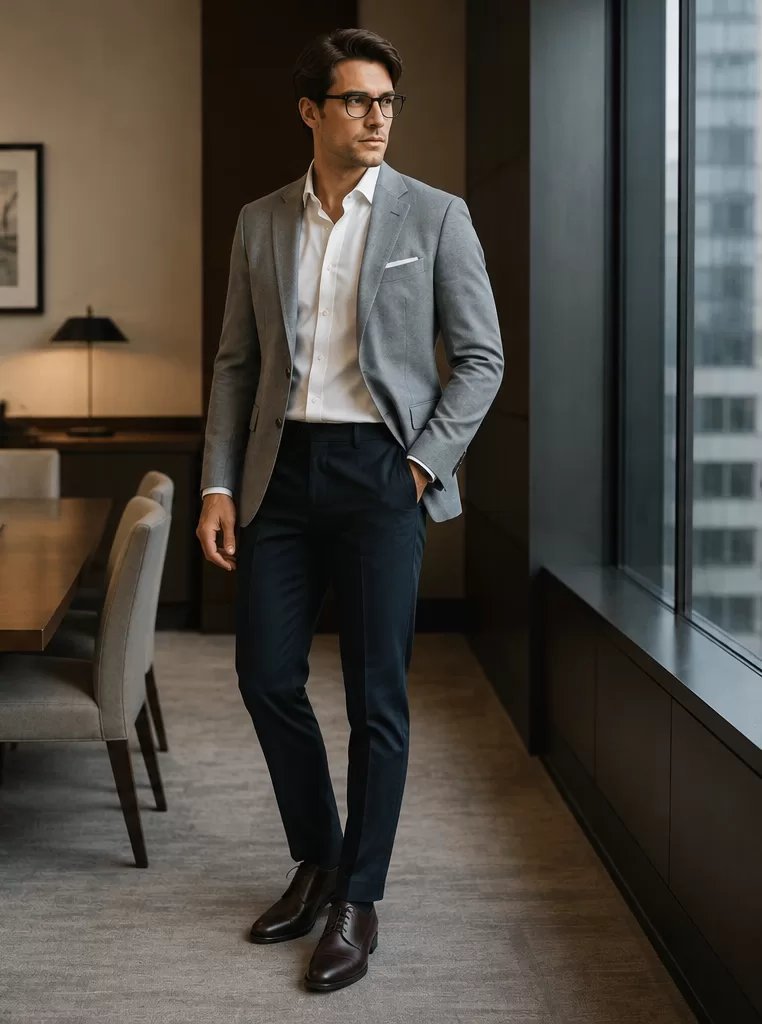
How do I dress smart casual for the office in the UK? Smart casual is the most useful — and most confusing — dress code in British working life. It means everything from “blazer but no tie” to “nice jeans are fine”, depending on the office, and getting it wrong in either direction is awkward. I’ve worked in smart-casual offices for years, including the minefield of “dress-down Fridays” and hybrid weeks, and the code is crackable. Here’s how to nail it consistently without overthinking every morning.
The definition that actually works: smart casual = polished and professional, but relaxed and comfortable. Think of it as “smart” minus the formality, not “casual” plus a blazer. The smart elements (tailoring, quality fabrics, neat grooming) do the heavy lifting; the casual elements (knits instead of shirts, clean trainers instead of brogues, dark jeans instead of suit trousers) keep it human. Get the balance right and you look competent and approachable — the exact signal most modern offices want.
How to dress smart casual for the office UK: the formula
The reliable formula: one tailored piece + quality basics + smart footwear. Examples:
- Blazer + plain tee + dark jeans + loafers
- Smart knit (merino crew or polo) + chinos + clean white trainers
- Shirt (untucked or half-tucked) + tailored trousers + brogues or smart boots
- Blouse + midi skirt + ballet flats or low heels
- Quality jumper + dark jeans + Chelsea boots
- Unstructured blazer + Breton top + tailored trousers + loafers
Notice the pattern: nothing ripped, nothing gym-wear, nothing beach-wear — but nothing that requires a tie or a suit either. Each outfit has at least one piece with structure (blazer, tailored trousers, smart shoe) anchoring the relaxed pieces.
The smart-casual rules (UK office edition)
- Dark jeans: yes. Ripped/faded jeans: no. Dark indigo or black jeans, no distressing, read as smart in most modern offices. Anything ripped belongs to the weekend.
- Trainers: clean and minimal only. White leather trainers (Common Projects style, or the £40 high-street versions) work; running shoes don’t. If in doubt, wear a smart shoe.
- T-shirts: plain and quality. A good plain tee under a blazer is smart casual perfection; a graphic tee is not. Fabric weight matters — see where can i buy quality basics on the high street uk.
- Knitwear is your friend: merino crew necks, fine-gauge polos, cashmere-blend jumpers — the smart-casual workhorses. More versatile than shirts for most offices.
- Blazers, unstructured: soft-shouldered, unlined blazers bridge the gap perfectly. One navy blazer transforms everything beneath it.
- Grooming counts double: smart casual lives or dies on polish — clean shoes, neat hair, pressed clothes. The relaxed clothes demand more grooming, not less.
Calibrating to YOUR office
Smart casual varies enormously. Week one in a new job: observe and match the best-dressed person at your level, then relax gradually. Signals to read: do senior people wear jeans? Are trainers common or rare? Is there a visible difference between client-meeting days and normal days? When clients visit, level up one notch automatically — that’s the professional instinct that gets noticed.
Hybrid complication: office days can be slightly smarter (you’re visible), WFH days more relaxed — but keep the “polished” baseline for video calls (how do i look polished while working from home). And keep a blazer on the back of your office chair: instant upgrade for surprise meetings.
Building a smart-casual capsule
You don’t need much: 2 blazers (navy + one other), 4–5 quality knits/shirts, 2 dark jeans, 2 chinos/tailored trousers, 2–3 pairs of smart shoes (loafers, white trainers, boots), 1–2 skirts/dresses if you wear them. That’s 15ish pieces generating dozens of combinations — the capsule logic from how do i build a capsule wardrobe on a budget uk applied to work. Buy the shoes and blazer well; save on the tees and knits.
Women navigating office dress codes specifically should read what is business casual for women in the uk — it covers the nuances (and double standards) in detail. And for the interview that gets you into the office, what should i wear to a job interview in the uk.
What to avoid
Sportswear (gym leggings, hoodies, running shoes) — the most common smart-casual failure. Anything you’d wear to the beach or the pub garden. Overly formal (full suit when nobody else wears one — it reads as not reading the room). And the “I gave up” look: smart casual still requires effort; the goal is effortless, not effort-free.
Smart casual shopping list (starter capsule)
If you’re building from scratch, buy in this order: 1. Navy unstructured blazer — the anchor. 2. Dark indigo jeans — the base. 3. White leather trainers or loafers — the footwear. 4. 2 merino crew-neck jumpers (navy, grey). 5. 2 quality plain tees (white, black). 6. Chinos or tailored trousers. 7. A smart shirt. That’s 10 pieces, roughly £250–£350 on the high street, generating 20+ outfits.
Buy the blazer and shoes at the best quality you can afford — they’re the credibility pieces. Save on tees and jumpers (Uniqlo, M&S). And remember: smart casual is a range, not a uniform — once the foundation is built, add personality through colour, texture and accessories. The goal is to look like the most polished version of yourself, not a catalogue.
The Friday question: how casual is too casual?
Dress-down Fridays (where they still exist) trip people up: the office says “casual” but means “slightly more relaxed smart casual”, not gym kit. Safe Friday formula: keep one smart element (blazer or smart shoe) and relax one other (jeans instead of chinos, knit instead of shirt). Never relax both — that’s how “dress down” becomes “gave up”. And when in doubt, ask a trusted colleague what Friday really means here; every office has its own unwritten version.
It is worth knowing your rights at work via Citizens Advice if dress code disputes arise.
The takeaway
How do you dress smart casual for the office in the UK? One tailored piece + quality basics + smart footwear, calibrated to your specific office by observing the best-dressed peers. Dark jeans yes, rips no; minimal clean trainers yes, running shoes no; polish always. Build a small capsule, keep a blazer handy, level up for clients. Nail this and getting dressed for work becomes the easiest part of your day.